

We are living through an era of unprecedented transformation, driven by the relentless evolution of artificial intelligence (AI). Every day, AI adapts, learns, and reshapes industries, pushing the boundaries of what was once thought possible. As we stand at this crossroads, one sector experiencing a massive shift is renewable energy. Yes, you read that right; wind and solar energy companies are embracing this new dawn of evolution, leveraging AI to tackle challenges that were unimaginable a decade ago.
For wind energy operators, data is the lifeline of their operations. Wind farms monitor and analyze a myriad of metrics daily, including turbine vibrations, gearbox temperatures, rotational speeds, wind speeds, wake effects between turbines, and even dirt accumulation on turbine blades. If left undetected, these issues can escalate, reducing energy output and increasing wear and tear on critical components, ultimately leading to higher maintenance costs and operational disruptions. Even minor inefficiencies, such as fluctuations in blade rotation or subtle changes in gearbox performance, can go undetected for days or even weeks. By the time these issues are identified, the damage may already be done, resulting in costly repairs and significant downtime that could have been avoided with timely intervention.
How AI is revolutionizing wind turbine maintenance
AI-driven predictive maintenance leverages vast amounts of data collected from sensors embedded in wind turbines. These sensors monitor various parameters, such as vibration, temperature, and rotational speed, providing real-time data on the health of the turbines. AI algorithms analyze this data to detect patterns and anomalies that may indicate potential failures.
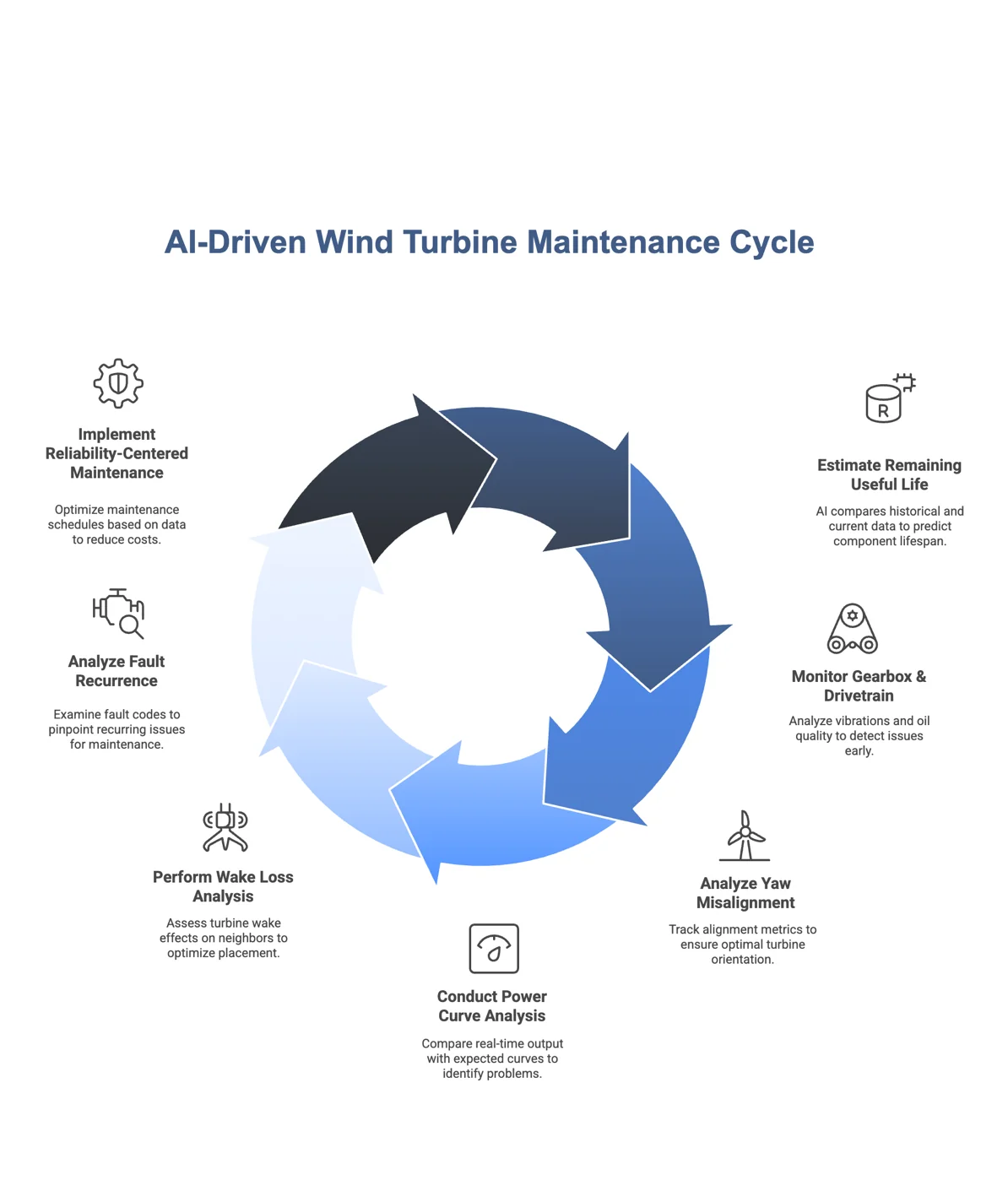
Yet, predictive maintenance goes far beyond just spotting anomalies. Advanced AI analytics now include:
- Remaining Useful Life (RUL) ModelsBy comparing historical operational data with current sensor readings, AI can accurately estimate how long critical components (like gearboxes, blades, and generators) will continue functioning optimally.
- Gearbox & Drivetrain MonitoringAI-driven analysis of vibrations, oil quality, and torque loads enables early detection of gear wear, bearing damage, and misalignment. Predictive maintenance scheduling reduces downtime and prevents unexpected failures.
- Yaw Misalignment AnalysisEven slight deviations in yaw alignment can lead to substantial performance losses. AI-powered tools continuously track alignment metrics, identifying misalignments early and ensuring turbines face the wind at the optimal angle.
- Power Curve AnalysisComparing real-time power output against expected power curves under specific wind conditions helps detect underperformance caused by blade soiling, pitch errors, or other mechanical issues.
- Wake Loss AnalysisAI can determine how a turbine’s wake affects its neighbours, which is crucial for optimizing turbine placement and adjusting operational parameters to maximize energy yield.
- Fault Recurrence AnalysisAI examines wind turbine fault codes to identify recurring issues, enabling targeted maintenance and design improvements to enhance reliability.
- Reliability-Centered Maintenance (RCM)AI enhances RCM by optimizing maintenance schedules based on reliability data and component criticality, reducing risk and cost.
Key benefits of AI in predictive maintenance
- Reduced Downtime: Maintenance activities can be scheduled during low-demand periods, ensuring uninterrupted energy production.
- Cost Savings: Early detection of issues prevents expensive emergency repairs and extends the lifespan of critical components.
- Enhanced Reliability: Continuous monitoring ensures turbines operate at peak performance, boosting overall reliability.
Why you should embrace predictive maintenance now
The renewable energy market is becoming increasingly competitive. With AI-driven predictive maintenance:
- Operators can proactively mitigate risks associated with equipment failure.
- Companies gain a competitive edge by ensuring consistent energy output and reducing operational costs.
- The long-term savings far outweigh initial investments in AI technology.
As industry leaders continue to prove the efficacy of predictive maintenance, it’s clear that adopting this approach is not just an option, it’s a necessity for sustainable growth in wind energy operations.
A decade ago vs. today: The AI Revolution
Imagine if someone had told you ten years ago that manual labour hours spent on monitoring these systems could be eliminated. Or that you wouldn’t have to constantly react to equipment failures because a technology could predict them before they happen. It would have seemed far-fetched back then: a pipe dream. But today, this is reality. AI-driven predictive maintenance has emerged as the game-changer for wind energy operators.
This technology doesn’t just automate menial tasks; it redefines efficiency. By analyzing real-time data from embedded sensors and historical trends, AI can anticipate equipment failures with remarkable accuracy. It allows operators to schedule maintenance proactively rather than reactively, reducing downtime by up to 35% and cutting maintenance costs by as much as 25%.
Why GreenBridge is your partner in predictive maintenance
At GreenBridge, we understand that the future of wind energy lies in innovation and efficiency. Our advanced AI-data agents and AI solutions are designed to empower operators with actionable insights, enabling them to prevent costly failures and optimize turbine performance. By leveraging AI-driven analytics, GreenBridge equips wind energy companies to stay ahead of potential issues, ensuring uninterrupted energy production and reduced operational costs.
As a trusted partner in the renewable energy industry, GreenBridge is committed to driving sustainable growth while delivering tangible results. With our expertise and cutting-edge technology, we help operators not only adapt to the challenges of today but also thrive in the opportunities of tomorrow. The time to act is now! Let GreenBridge guide your transition to smarter, more efficient wind energy operations. Together, we can build a greener, smarter future.