


AI-driven energy asset management turns alarms, work orders and documents into decisions. Three strategies deliver the most for renewable operators today: predictive maintenance that ranks faults and surfaces repair steps, work order automation that closes the fault-to-fix loop, and document intelligence that makes manuals, fault code libraries and contracts instantly searchable.
Why operators are moving beyond manual tools
Running renewable operations means balancing uptime, compliance and cost across increasingly complex assets. Technicians face a flood of alarms, operators juggle reporting requirements and asset managers must make financial decisions with confidence. Manual reporting, fragmented systems and reactive fixes do not scale with portfolio growth. AI changes that by turning raw data and documents into actionable insight, so teams can move from firefighting to proactive operations.
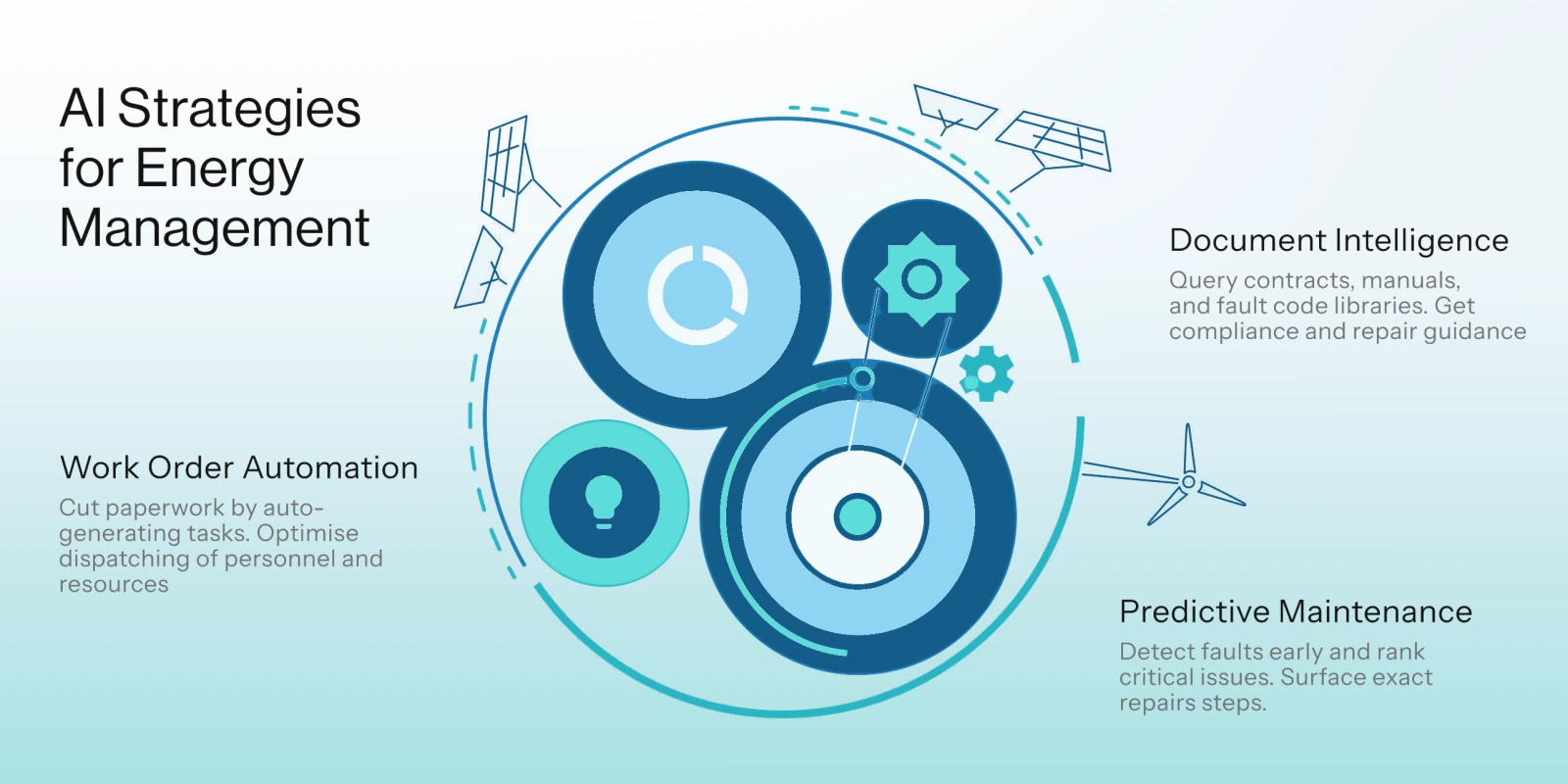
Three AI strategies at a glance
- Predictive maintenance: detect faults early, rank critical issues and surface exact repair steps.
- Work order automation: cut paperwork by auto-generating tasks and optimizing dispatch.
- Document intelligence: query contracts, OEM manuals and fault code libraries for compliance and repair guidance.
1. Predictive maintenance: from alarms to action plans
Predictive maintenance has been discussed in energy for years. Its potential is realized when AI turns alarms into action plans. Traditional SCADA systems trigger alerts and often overwhelm teams with warnings. AI goes further:
- Correlating signals: vibration data, SCADA values and historical failures are analyzed together to find root causes.
- Prioritizing by impact: instead of hundreds of equal-priority alarms, AI highlights the issues most likely to cause downtime.
- Guided troubleshooting: AI surfaces the relevant OEM manual or previous repair record, so technicians get step-by-step guidance.
Takeaway for operators: the more complete and structured your fault logs and maintenance history are, the better AI predicts and guides fixes.
2. Work order automation and dispatch: closing the loop faster
Fixing a fault often takes less time than the admin needed to log it, raise a work order, assign it and report on it. For many O&M teams, this is where efficiency breaks down. AI streamlines the whole fault-to-fix workflow:
- Work order creation: alarms become structured tasks with the key details filled in.
- Dispatch optimization: jobs go to the best-suited technician based on expertise, proximity and workload.
- Feedback loops: completed work orders update automatically and feed data back into the system.
Takeaway for technicians: expect less form-filling and more time fixing. Automated dispatch means fewer delays, repeat visits and scheduling conflicts.
3. Document intelligence: unlocking knowledge in manuals and contracts
Much of the critical knowledge in energy operations sits in PDFs and static documents: OEM manuals, SOPs, fault code libraries and contracts. Teams lose hours digging through them when issues arise or audits approach. AI-powered document intelligence changes that:
- Fault code libraries: a technician queries a fault code and gets the OEM-recommended troubleshooting steps at once.
- Contract terms: asset managers extract compliance obligations, warranty conditions or penalty clauses in seconds instead of reading dozens of pages. This is the ground our Revenue Assurance modules work on.
- Audit-ready compliance: teams pull evidence from manuals and contracts to build accurate, audit-proof reports quickly.
Takeaway for asset managers: treat documents as dynamic, searchable assets. Document intelligence saves time, reduces compliance risk and makes sure teams act on the right information.
What each strategy needs to get started
| Strategy | Data and inputs required | First metric to track |
|---|---|---|
| Predictive maintenance | SCADA readings, vibration data, fault logs and maintenance history | False-alarm rate; time to repair (MTTR) |
| Work order automation | Alarm feed, CMMS access, technician skills and locations | Alarm-to-dispatch time; repeat visits |
| Document intelligence | OEM manuals, SOPs, fault code libraries and contracts | Time to find a repair step or clause; audit-evidence preparation time |
To see how these strategies sit inside a wider platform, read Top 10 APM Use Cases for Wind & Solar and Traditional APM vs AI-Powered APM.
Frequently asked questions
- What data is most useful for AI-driven predictive maintenance?
- Mainly SCADA readings, vibration data and past fault logs. Together they let AI detect failure patterns earlier than traditional monitoring.
- Will AI change how technicians work day to day?
- Yes. Less time on paperwork and searching, more time on targeted repairs with clear guidance.
- Does AI replace technicians or operators?
- No. AI surfaces the right information, but skilled people still make the decisions and do the work.
- How is document intelligence different from search?
- Search lists every mention. Document intelligence pulls the relevant repair step or contract clause directly.
- How can operators start applying these AI strategies?
- Start small: a predictive maintenance pilot or automated reporting delivers quick wins before you scale across all assets.
Conclusion: building smarter, more resilient operations
AI-driven energy asset management is not about replacing people. It lets operators and technicians focus on the work that matters: fixing issues faster, managing risk early and making confident decisions. Predictive maintenance means fewer surprises in the field, automated work orders mean less paperwork and more action, and document intelligence means no more wasted hours searching. For asset owners that adds up to stronger returns and compliance confidence. For technicians it means clearer guidance with less admin.
Want to see these three strategies working on your own assets? Book a walkthrough.